TL;DR: Not every listing needs drone photos — but the right ones are undermarketed without them. If your listing has a view, a large or unusual lot, a hillside setting, a facade that’s hard to capture from the street, or an exterior worth showing in full, aerial photography adds clear value. For standard homes with traditional lots and most condo and apartment units, aerial photography and video is optional — and in many cases, well-executed standard photography and Twilights will do more to market those listings effectively. Use the quick reference table below to help you make the call.
Key takeaways
- Aerial adds the most value when there’s something worth showing from above — views, large lots, hillside settings, hard-to-capture facades, outdoor features, and luxury listings.
- If your listing is a high-rise condo or a standard suburban home on a flat lot, aerial is worth weighing carefully. Strong interior photography — both standard and twilight — will often do more for those listings, though there are cases where aerial still makes sense.
- Bay Area weather can ground drones for a variety of reasons. Fog, rain, and wind can all make flight unsafe or impractical — and conditions can change quickly, especially in San Francisco. Staying on top of the forecast in the days before your shoot is part of getting aerial right.
- Every aerial shoot includes a complimentary Aerial Spotlight edit, which highlights the full lot and gently darkens everything else so buyers can see exactly what’s part of the property. Custom callouts for nearby schools, parks, and other points of interest are available for an additional editing fee.
- All Open Homes drone operators are FAA Part 107 certified. Airspace authorizations for restricted zones are handled as part of your booking — you don’t need to manage this.
- Aerial add-on pricing starts at $200 for photos and $250 for video when combined with an existing full shoot.
What do drone photos for real estate actually show?
Drone photography captures your listing from above — from as low as 10 to 20 feet off the ground up to 400 feet, depending on FAA regulations, the property, and what needs to be shown. The end product is a set of aerial stills, and optionally video, that puts your listing in full context: lot size and shape, the relationship to the street and neighbors, views across the Bay or the hills, and outdoor features like pools, gardens, or decks that regular photography can’t fully convey.
The practical difference comes down to perspective. Ground shots show your buyers what a home looks like from the street. Aerial shots show them where it sits — how it relates to the neighborhood, what’s around it, and its broader setting. For most buyers, that context matters as much as the home itself.
Take 70 Graystone Terrace in San Francisco. The ground-level shot shows a handsome white stucco home — you can see the terraced planters, the facade, and even get a rough sense of the levels. However, the aerial shot reveals something else entirely: a towering old-growth cypress, a full cascade of planted terraces that extend deep into the lot, and a home that occupies a much larger footprint than the street view suggests. The street shot is accurate, but the aerial shot is complete.
-
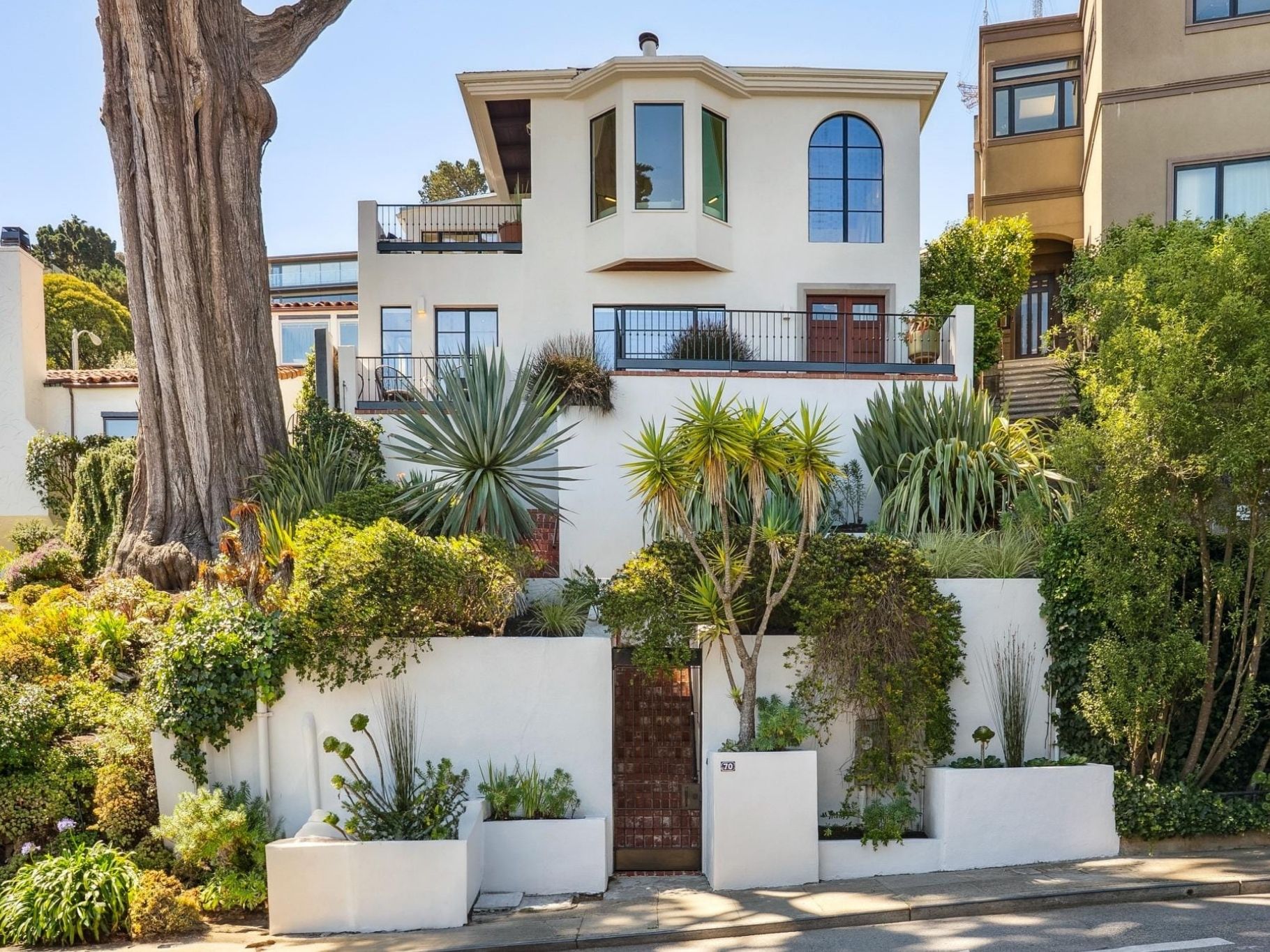
Exterior Photography — 70 Graystone Terrace, San Francisco
The view from the street: 70 Graystone Terrace, San Francisco
-
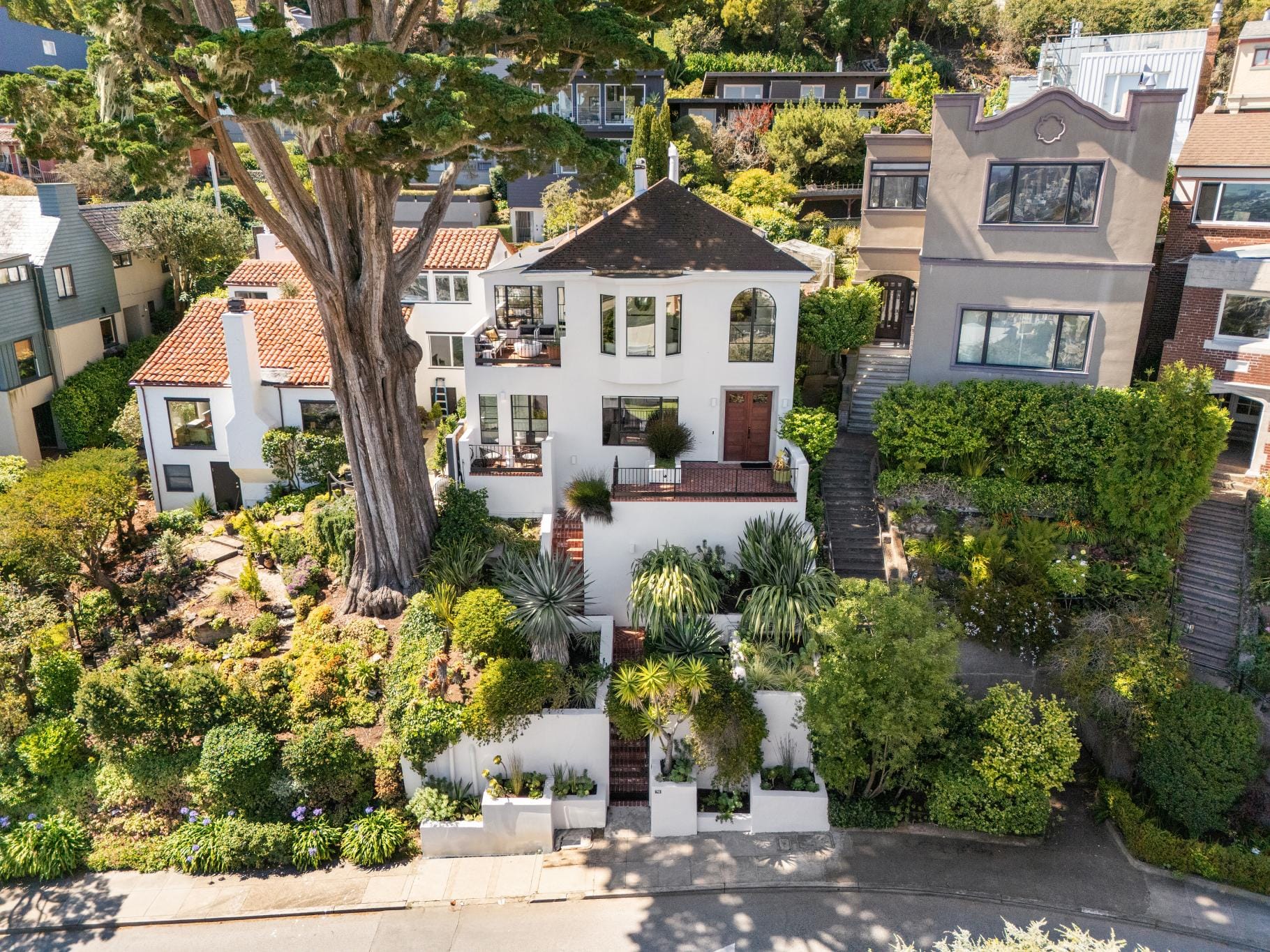
Aerial Photography — 70 Graystone Terrace, San Francisco
An aerial shot shows the full scale of the home and front yard
When aerial photography genuinely helps a listing sell
Aerial makes the biggest difference when you have something worth showing from above. Here are the scenarios where drone footage consistently pays off:
Properties with views
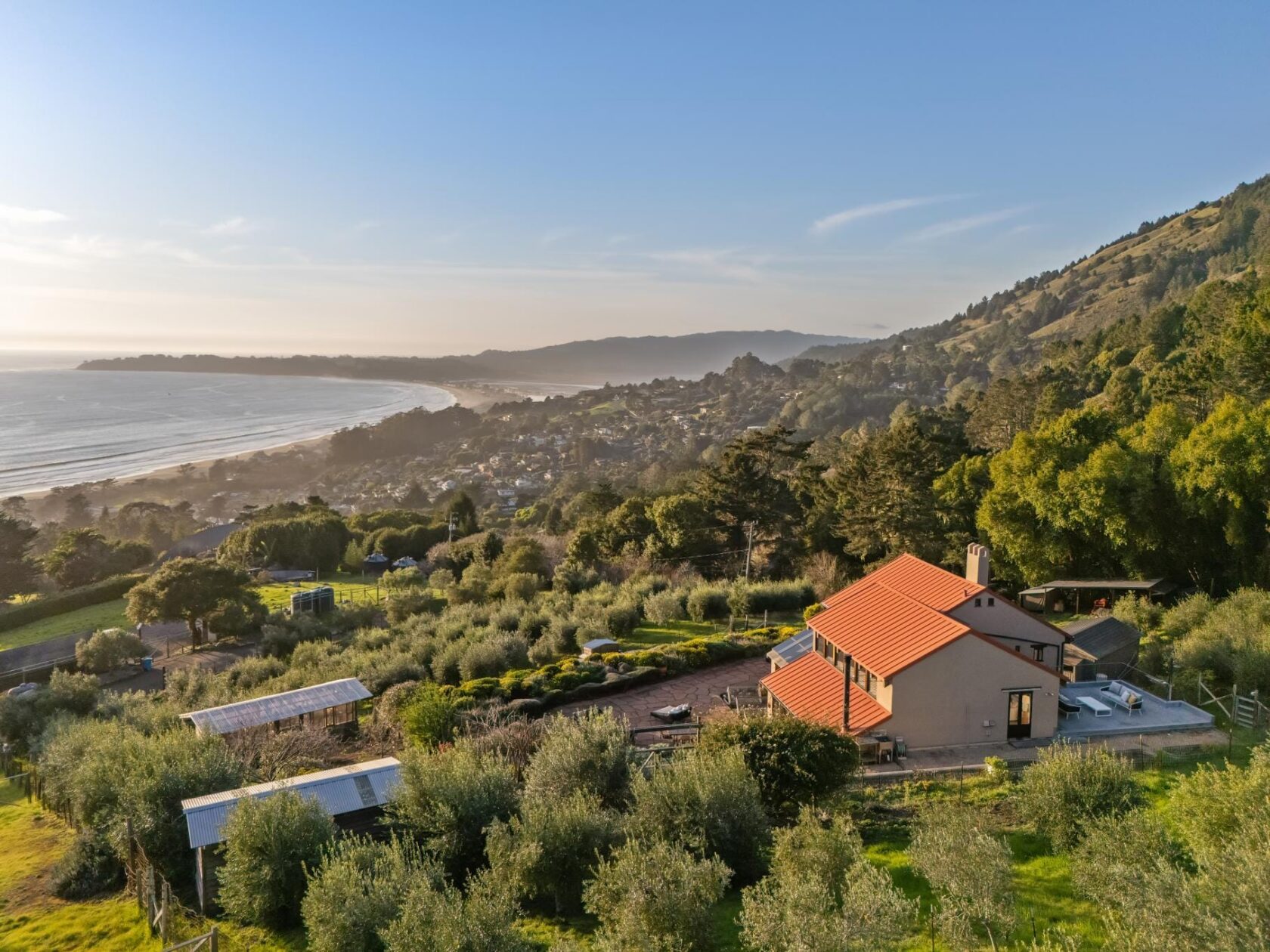
Bay Area homes come with a variety of views — the Pacific, the Golden Gate Bridge, Mt. Tamalpais, city skylines, the Bay. Ground-level shots show buyers the view from a window or a deck — which matters, because that’s the view they’ll actually experience every day. Aerial photography shows them that the view is there and the scale of it, which is what could turn a scroll into a scheduled tour.
Take 6986 Panoramic Highway in Stinson Beach — the aerial, taken at golden hour, shows the home sitting above Stinson Beach, with the Pacific coast curving out below and the hillside orchard and outbuildings all visible in a single frame. No ground shot from the driveway would be able to fully tell that story.
Large or unusual lots
In a market where lot size is a meaningful part of the price-per-square-foot conversation, showing your buyer the full footprint matters. A large parcel, a corner lot, a property with significant outdoor space, or a home with a long driveway and gated entrance all benefit from the overhead perspective that only aerial can provide. Your buyer scrolling through listings can’t gauge lot size from a front-elevation photo, while a single aerial shot can answer that question immediately.

The scale of this 14.5-acre lot could only be communicated using a drone
Some properties make this point on their own. 2800 Paradise Drive in Tiburon (above) spans 14.5 acres with 2,000 feet of San Francisco Bay shoreline — the largest remaining undeveloped stretch of shoreline in Marin County. There is no ground-level angle that could communicate that scale. The aerial shots here aren’t a marketing choice, they’re the only option. 215 Kreuzer Lane in Napa (below) sits on 5.35 acres surrounded by vineyards, with the Mayacamas and Vaca Mountains in the background — a lot whose full character only becomes clear from a bird’s eye view.

Luxury homes
At the upper end of the Bay Area market, some discerning buyers and their agents expect aerial as part of a complete marketing package — the same way they expect professional photography, a Video Tour, and a dedicated property website. Rather than being thought of as an add-on, in highly competitive markets, it is now considered a baseline.
Skipping aerial on a high-end listing is noticeable. Buyers at this level are often comparing multiple properties with polished marketing across the board, and a listing that’s missing aerial coverage can look like it wasn’t given the full treatment — regardless of how strong the interior photography is.
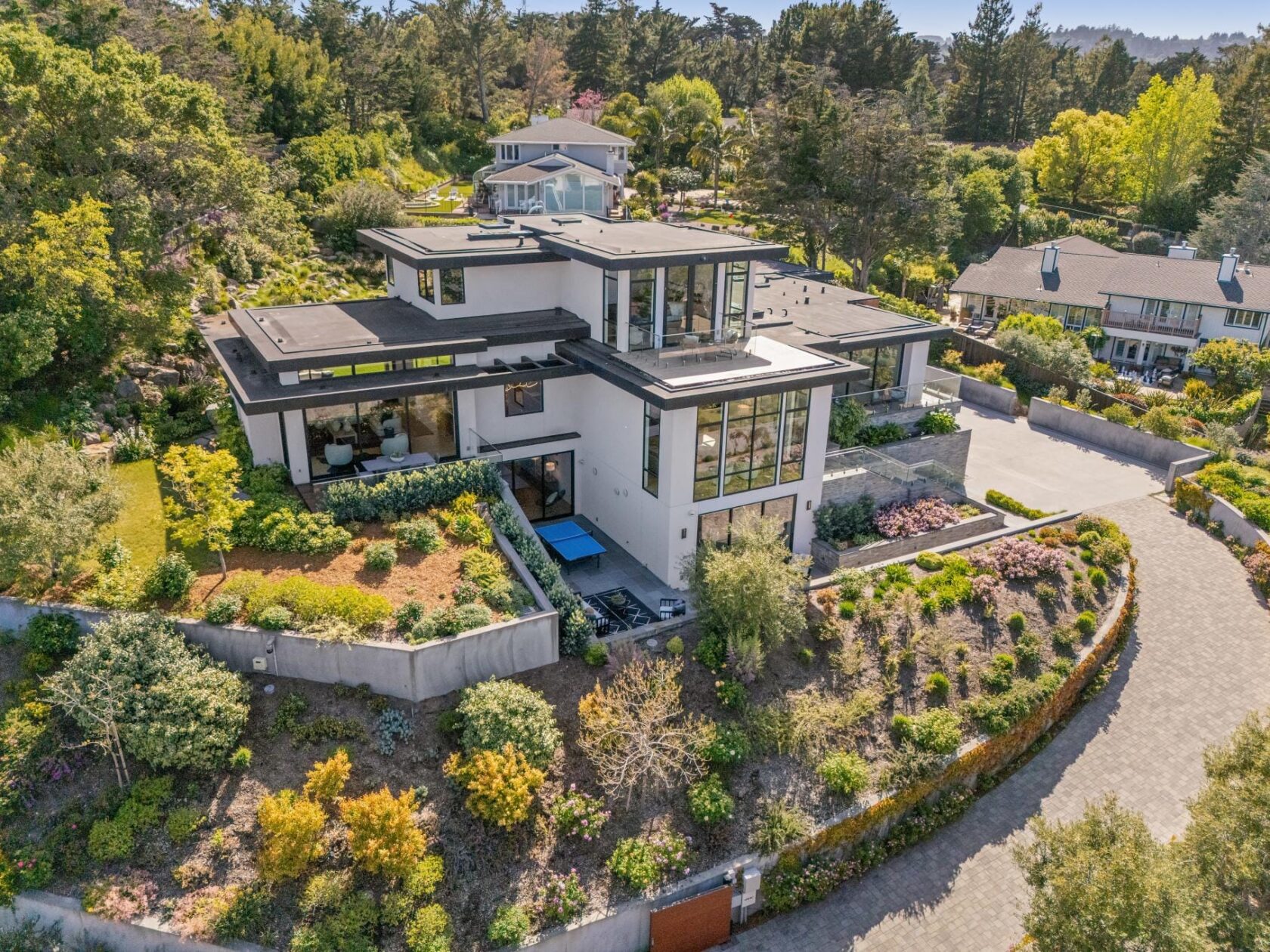
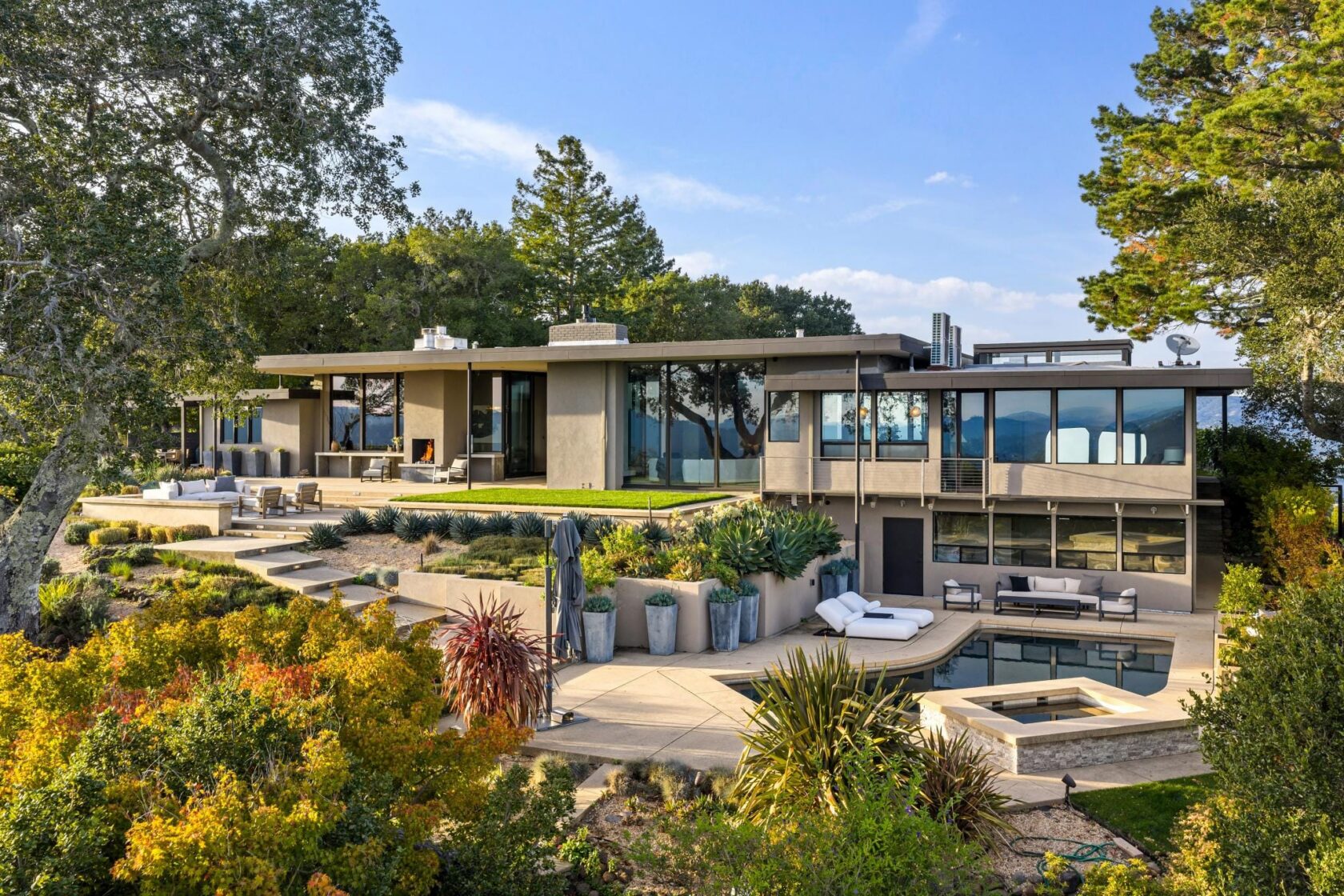
855 Darrell Road in Hillsborough (above) is a three-level contemporary estate with Bay views and terraced gardens — the kind of property where the aerial shot is doing real work, showing the full scope of the home, its multiple levels, and its setting in a way that interior photography alone never could. 87 Oakmont Avenue in San Rafael (below) makes a similar case: more than 2,000 square feet of outdoor living space, a pool, a spa, and a separate studio, all set into a hillside lot that only makes sense from above.
Properties with notable outdoor features
Some special listings have major outdoor appeal in the form of a pool, tennis court, orchard, or guest house — and some have all of those features and more. The greater number of features, however, the harder it is to capture everything from the ground. One aerial shot shows all of it together, giving your buyers an immediate sense of the full property without needing to piece it together from multiple photos.
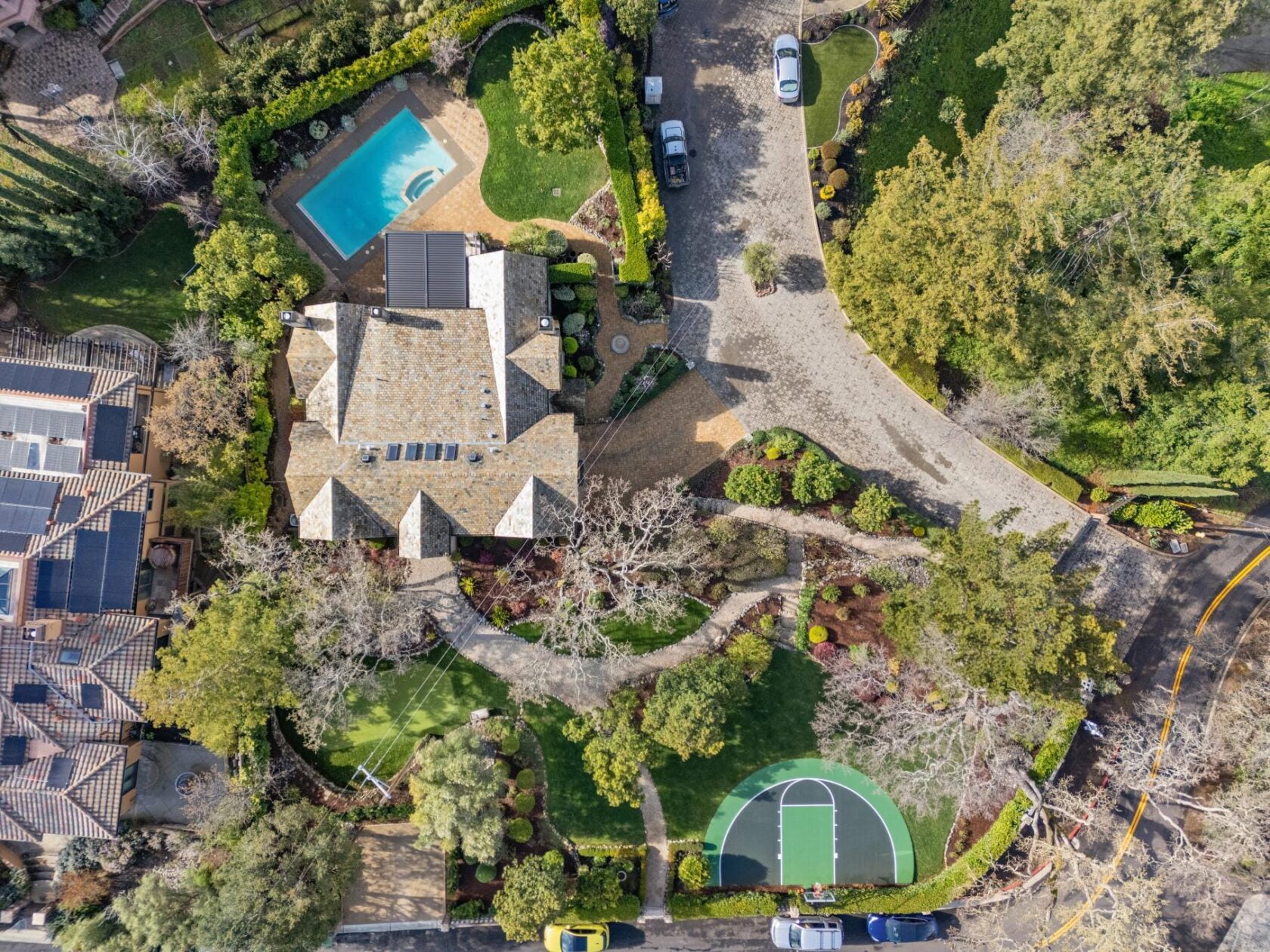
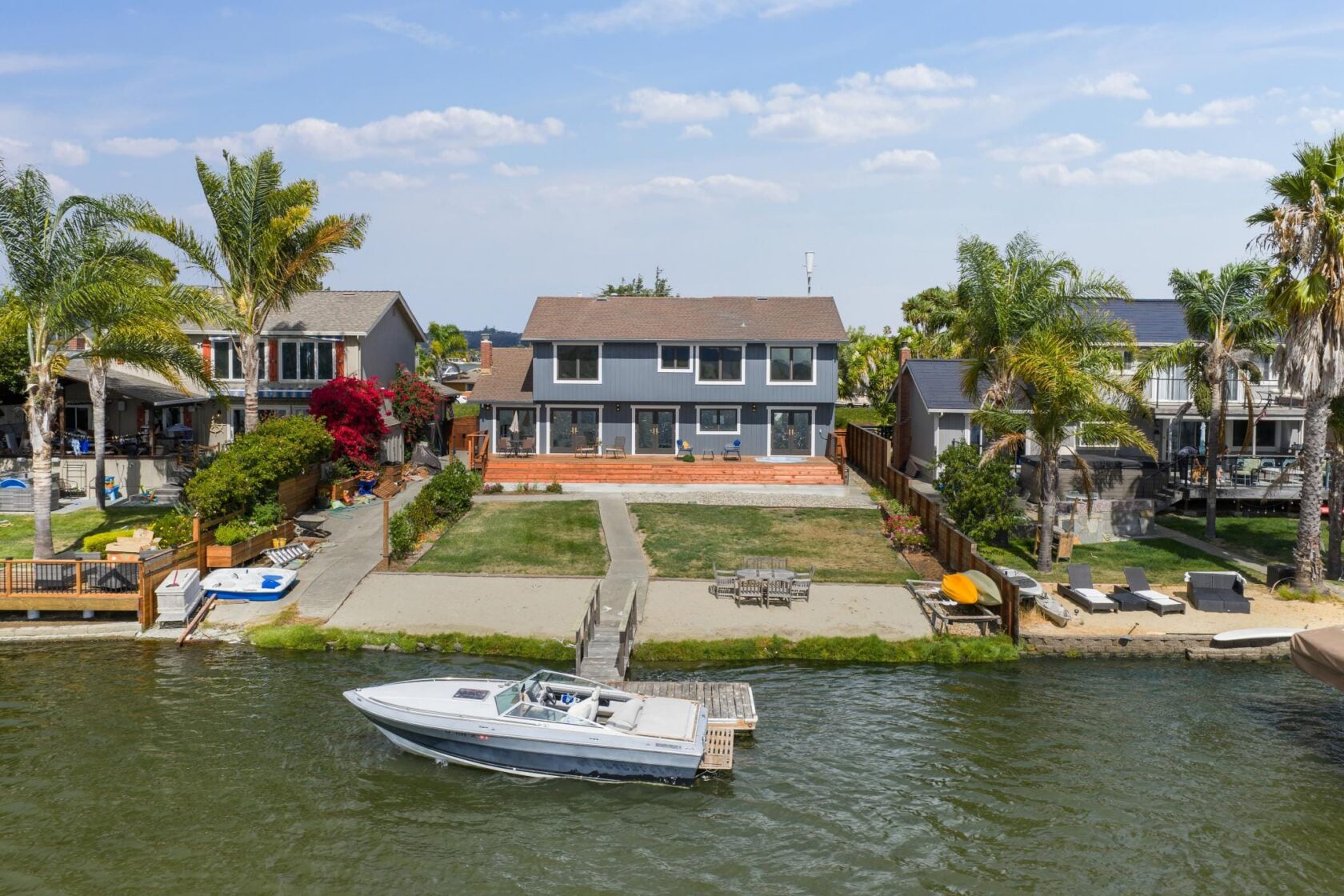
90 Reservoir Road in Los Gatos (above) illustrates this point: pool, fountain, outdoor kitchen, basketball court, and a putting green, all visible from above in a single shot. At 1066 Bel Marin Keys in Novato (below), the feature is the waterfront itself — a private pier, a landscaped yard stepping down to the water, and a boat at the dock. Without aerial, neither property can be fully captured and appreciated.
Homes where the facade can’t be fully captured from the ground
Not every aerial shot has to be the classic high-altitude overhead view. Sometimes a drone is simply the only way to get a clean, complete image of the home itself — and a low aerial shot, taken from as little as 10 to 20 feet up, is the tool that makes it possible.
255 Stanford Avenue in Kensington (below) is a clear example. From the street, you get one of two unsatisfying options: a view looking up the hillside where the home is almost entirely eclipsed by the garage, or an extreme close-up that captures a single level at a time. Neither shows the house. The low aerial solves it in one frame — the full facade, the terraced decks stepping down the lot, the entry, and the landscaping all visible together. It’s not a dramatic overhead; it’s simply the only angle that shows the home as it actually is.
-

255 Stanford Avenue — street view
From the street, the home is almost entirely eclipsed by the garage — there’s no ground-level angle that shows the facade.
-

255 Stanford Avenue — entry close-up
This close to the home, the yard is so tight there’s no room to step back and capture the facade — you get the entry and deck, but not the house as a whole.

The low aerial is the only angle that shows the whole home — full facade, terraced decks, entry, and yard, all in one frame.
Hillside homes like this are the clearest case. The Bay Area has no shortage of them, and they’re notoriously difficult to photograph from the ground. The terrain, the elevation changes, the surrounding landscape — all of that is part of what makes your listing desirable, and it doesn’t translate well in a standard photo shoot. 363 Marion Avenue in Mill Valley (below) is another good example: the home has multiple levels that step down through the redwoods, and ground shots can only capture one level at a time. A low aerial shows the full structure and how it sits within the tree canopy — information a buyer genuinely needs before deciding whether to schedule a tour.
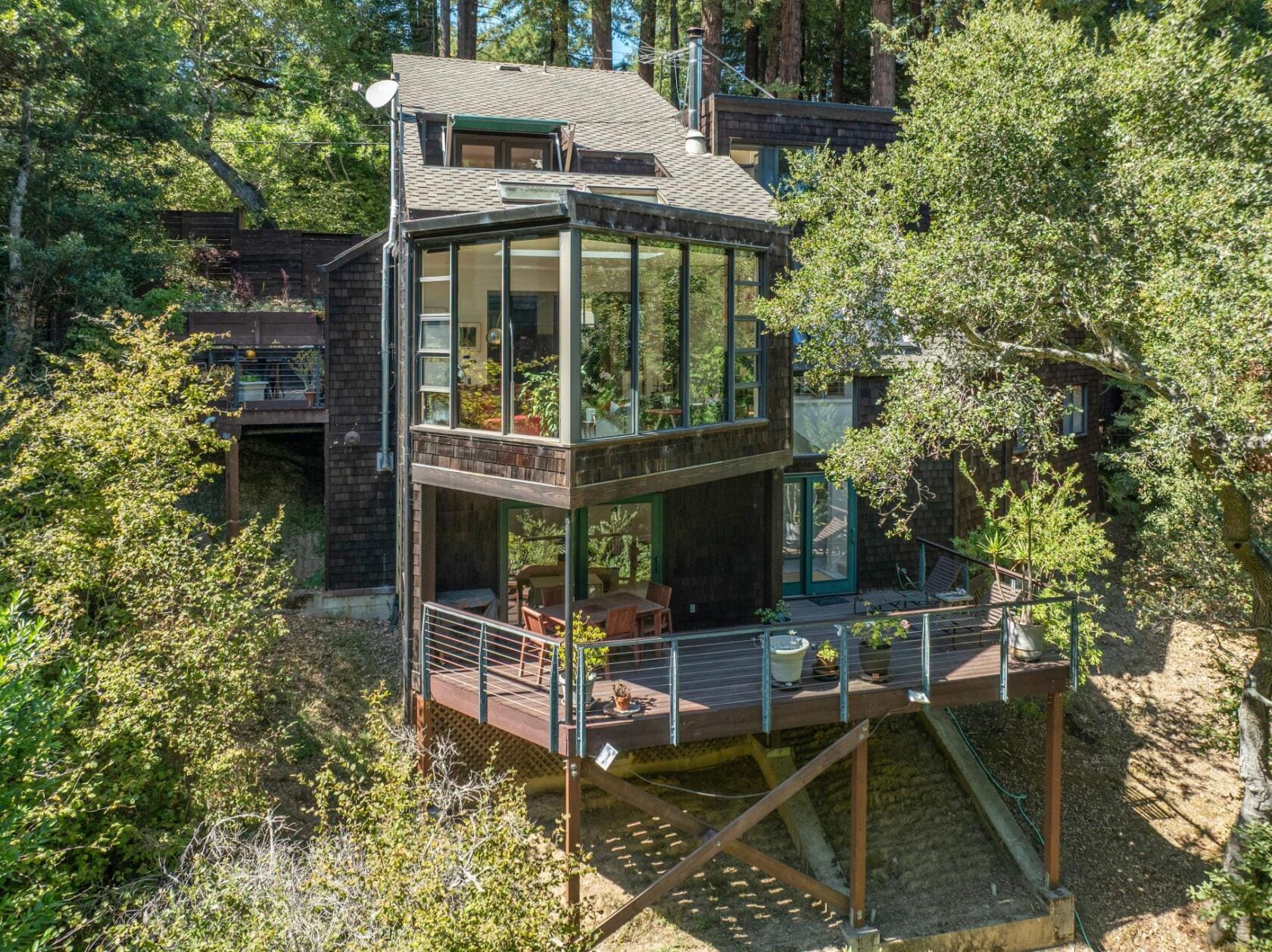
But the same problem comes up on plenty of non-hillside listings. A home set far back behind mature trees, a tall facade that won’t fit in frame from a narrow street, a property where parked cars or power lines clutter every ground-level angle, or a multi-level home where no single sidewalk vantage point captures the whole front — all of these are cases where a low aerial gets you the facade image you simply can’t get from the street. The drone isn’t there for the dramatic overhead; it’s there to take the photo the property deserves and the ground won’t allow.
When aerial footage may not be top priority
Even though we’ll be the first to tell you that aerials have a ton of upsides, we’ll be honest: not every listing needs drone coverage. Being aware of that helps you spend your marketing budget on what will actually move the needle for that specific property.
Standard homes on flat lots
A typical home on a standard-sized lot doesn’t automatically need drone photos. If your listing doesn’t have many distinguishing features outside, or if there’s no view, the facade is easy to capture from the street, or if the neighborhood context doesn’t add to the property’s appeal, aerial photography is likely to produce shots that look similar to what you’d get with a wide-angle lens from the sidewalk, without the additional cost. Well-executed ground-level and twilight photography (we offer both traditional Twilight Shoots and Virtual Twilights) is the better investment for listings like these.
The aerial shot of 546 Norvell Street below is a fine image — but it doesn’t reveal anything a buyer couldn’t gather from a strong ground-level set. For listings like these, that budget is likely better spent elsewhere.
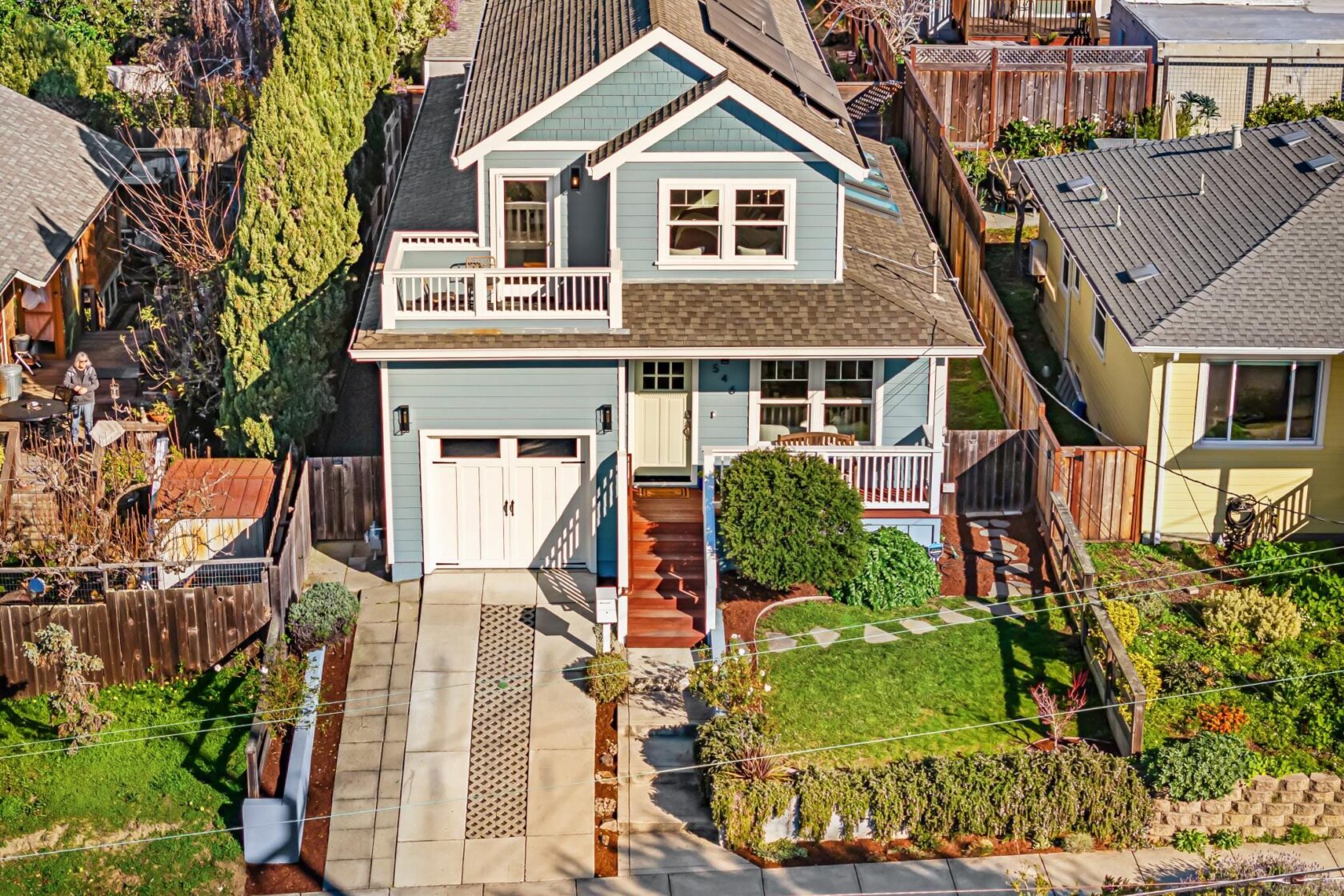
Aerial offers an interesting perspective, but doesn’t show anything that ground-level exteriors wouldn’t already cover.
Condos and apartments
For most condo units, aerial is worth thinking through carefully. A standard unit on a mid-level floor doesn’t stand out from above, and an aerial shot of the building exterior shows the building, not your unit. That said, aerial photography can be a genuinely useful tool for showing a building’s size, its relationship to the surrounding neighborhood, and proximity to landmarks or amenities that add to the listing’s appeal.
1000 North Point Street in San Francisco (below) shows the building’s position relative to the Bay, Galileo Academy Field, the Golden Gate National Recreation Area, and the northern waterfront — again, context that sells.
For top-floor units or penthouses with visible outdoor space, aerial is often worth it on its own. For a standard unit on a lower floor, the budget might be better spent on strong interior photography, a Video Tour, and a property website. Also, just a friendly reminder: If you ordered a property website with us, Open Homes automatically includes Common Area photos — for example, the pool, courtyards, or tennis courts — which cover much of what aerials are typically used to show.
-

Aerial Photography — 1000 North Point Street, San Francisco
The building’s position relative to the Bay, Galileo Academy Field, the Golden Gate National Recreation Area, and the northern waterfront
-
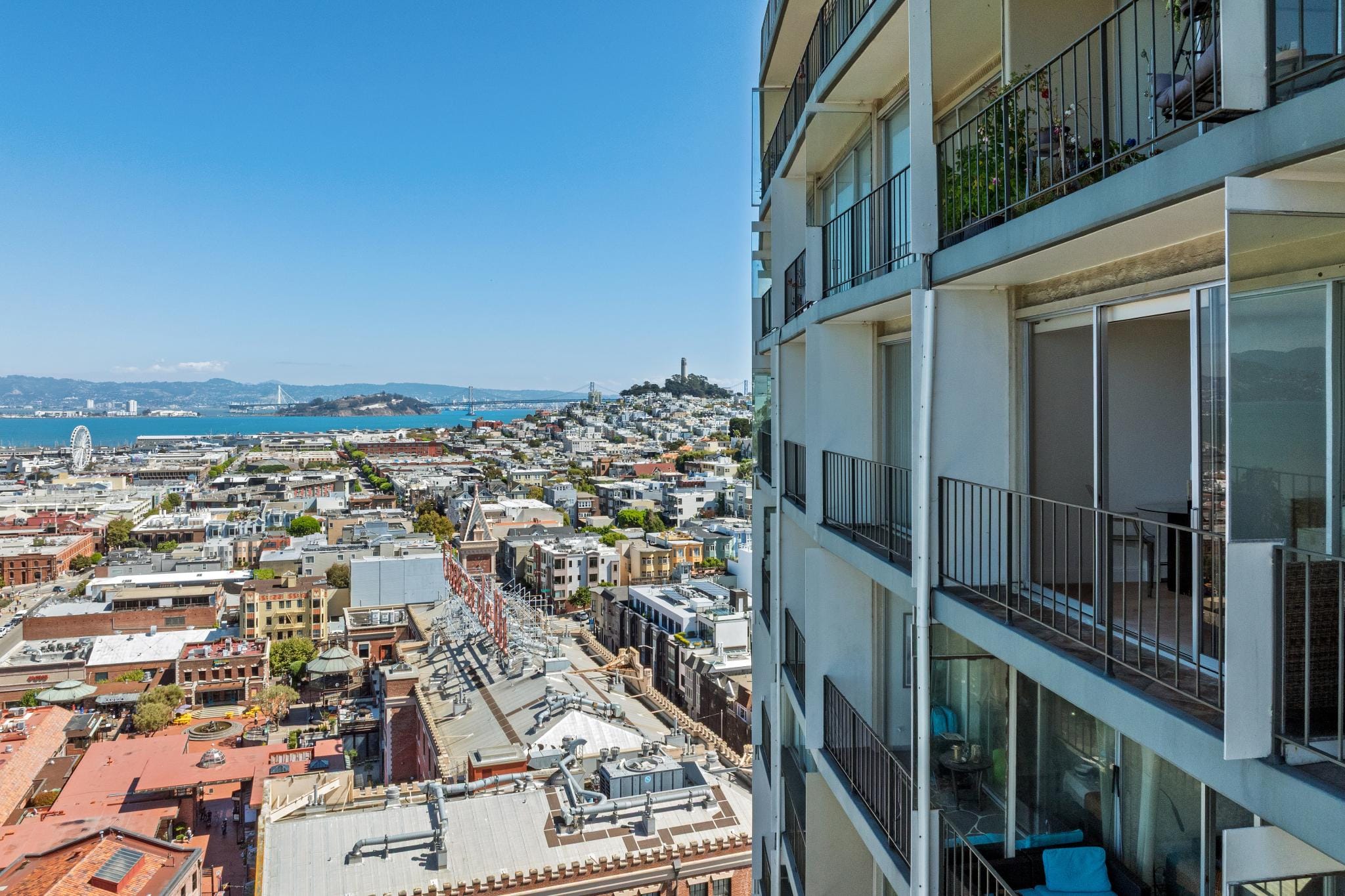
Aerial Photography — 1000 North Point Street, Unit Detail, San Francisco
The same building, zoomed in to show the unit’s balcony and the views it looks out over — North Beach, Coit Tower, and the Bay.
For listings like these, the better investment is usually a combination of strong interior photography, a Twilight Shoot, or a Virtual Twilight — services that consistently move the needle for standard homes, condos, and apartments. See our full list of services here.
Quick reference: aerial or no aerial?
Use this as a quick way to check if your listing might benefit from aerial.
| Property Type / Feature | Aerial Recommended? | Why | |
| Properties with views | Yes | Ground photos can show a view through a window. Aerial shows your buyers the full scale of what they’re buying. | |
| Large or unusual lots | Yes | Lot size is a major value driver in the Bay Area. A single aerial shot conveys scale that a front-elevation photo can’t. | |
| Luxury homes | Yes | Buyers at this level expect a complete marketing package. Without it, the marketing can feel incomplete. | |
| Properties with notable outdoor features | Yes | A pool, tennis court, ADU, or large garden is hard to show in a single ground-level frame. Aerial covers it all in one shot. | |
|
Yes | Hillside homes, homes set behind trees, tall facades on narrow streets — a low aerial gets the complete facade image the street can’t. | |
| Standard suburban home, average lot | Optional | Worth considering if curb appeal is strong or the backyard is a standout feature. | |
| Condos or apartments | Optional | Useful for showing a building’s size and neighborhood context, or for penthouse and top-floor units with visible outdoor space. |
Bay Area-specific considerations for your drone shoot
A few factors affect aerial planning in the Bay Area in ways that don’t come up in other markets.
Weather. Fog, rain, and wind can all ground your shoot — and in parts of the Bay Area, conditions can change quickly. San Francisco in particular can go from clear to fogged in under an hour, and drones can’t fly when visibility drops, when it’s raining, or when wind conditions make it unsafe to maintain visual contact with the aircraft. The best aerial conditions in SF are typically late morning to early afternoon, after the marine layer burns off but before afternoon winds pick up. If conditions on shoot day make aerial unsafe or impractical, reach out to our team to reschedule the aerial portion. The rest of your shoot will stay on track regardless of weather and will still look great, thanks to our complimentary blue skies replacement service.
FAA Part 107 certification. All commercial drone operations require FAA Part 107 certification, and all Open Homes pilots hold this certification.
Restricted airspace. Parts of the Bay Area fall within controlled airspace, particularly near Oakland International, SFO, and Moffett Field. Our pilots file the appropriate authorizations before any shoot in a restricted zone. That’s handled as part of your booking — you don’t need to worry about this.
HOA and neighborhood restrictions. Some planned communities and HOA-governed neighborhoods have their own restrictions on drone operations. If your listing is in a gated community or a neighborhood with an active HOA, it’s worth a quick check before booking.
Aerial Spotlight: a complimentary edit on every aerial shoot
Whenever aerial makes sense for your listing, there’s something we include automatically that makes those shots work harder. Every aerial photo we deliver comes with Aerial Spotlight at no extra cost: we highlight the complete lot and gently darken everything around it, so the property is “spotlighted” and it’s immediately clear what’s actually part of the home. On listings where lot lines are ambiguous — adjacent properties, shared driveways, large parcels where the boundary isn’t obvious — this does a lot of work. Buyers see exactly what they’re getting, and you don’t have to explain the property line in the listing remarks.
6204 Washington Street in Napa (below) shows why it matters. Surrounded by neighboring vineyards that look nearly identical from above, the property could easily blur into the land around it. With Aerial Spotlight, the parcel is held at full brightness while everything outside it is gently darkened — so a buyer can see exactly where the listing begins and ends at a glance.
Need to point out more than the lot? We can add custom callouts to nearby schools, parks, transit, shopping, or any other point of interest that strengthens the listing, for an additional editing fee. It’s an easy way to turn a single aerial into a quick visual map of why the location works.

Aerial Spotlight in action: the property is highlighted and everything outside it gently darkened, so it’s immediately clear what’s part of the listing.
Drone photography pricing for Bay Area listings
| Service | Price |
| Aerial photos (10–15 photos) | $300 |
| Aerial photos add-on* (1–7 photos, with existing shoot) | $200 |
| Aerial video (1–2 minutes) | $450 |
| Aerial video add-on* (15–30 seconds, with existing shoot) | $250 |
| Aerial Twilight Photography | $400 |
Add-on pricing requires a full on-site photography or video shoot.
Frequently asked questions
Can I add aerial photography to an existing booking?
Yes. Open Homes offers aerial as an add-on to any full on-site photography or video shoot. Add-on pricing starts at $200 for photos and $250 for video — the most cost-effective way to include aerial without booking a standalone session.
What is Aerial Spotlight, and does it cost extra?
Aerial Spotlight is a complimentary edit included with every aerial photo we deliver. We highlight the full lot and slightly darken the surrounding area so it’s clear exactly what’s part of the property — especially helpful when lot boundaries aren’t obvious from the photo alone. Custom callouts to nearby schools, parks, or other points of interest are available for an additional editing fee.
What happens if it’s foggy on shoot day?
If conditions on shoot day make aerial unsafe or impractical, reach out to our team to reschedule the aerial portion. Interior and ground-level photography stays on track.
What do I need to do to prepare the property for aerial photos?
Clear the driveway, remove any vehicles parked on the street in front of the property, and move items like recycling bins out of frame. Check out our blog post on How to Prepare Your Home for Photography for more tips to get your listing ready for its time in the spotlight.
Does my listing’s price determine whether aerial is worth it?
Not really. The better question is whether your listing has something worth showing from above — a view, a large lot, a hillside setting, a hard-to-capture facade, a prominent exterior, or outdoor features that ground-level photography can’t fully capture. A mid-range home with Bay views absolutely benefits from aerial. A condo on a lower floor of a high-rise might not. Go by property type and features, not list price.
What’s the difference between standard aerial video and FPV aerial video?
Standard aerial video is captured by a drone hovering or moving slowly at altitude, producing stable, wide establishing shots. FPV (First Person View) video uses a faster, more agile drone to create dynamic cinematic footage — flying through gates, around trees, down driveways — which gives the final video a polished, cinematic feel rather than an overhead survey. FPV is a separate Open Homes service, best suited for luxury properties and listings where a cinematic feel is part of the marketing strategy.
Have other questions not answered here? Check out our post on The Top Questions We Get About Drones in Real Estate Marketing or reach out to our team.
Ready to add aerials to your next Bay Area listing?
Get a quote instantly at app.open.homes/request or view full service details at open-homes.com/aerial-photography-and-video.